
Joseph R. Wolin
Elegies for a Fallen World
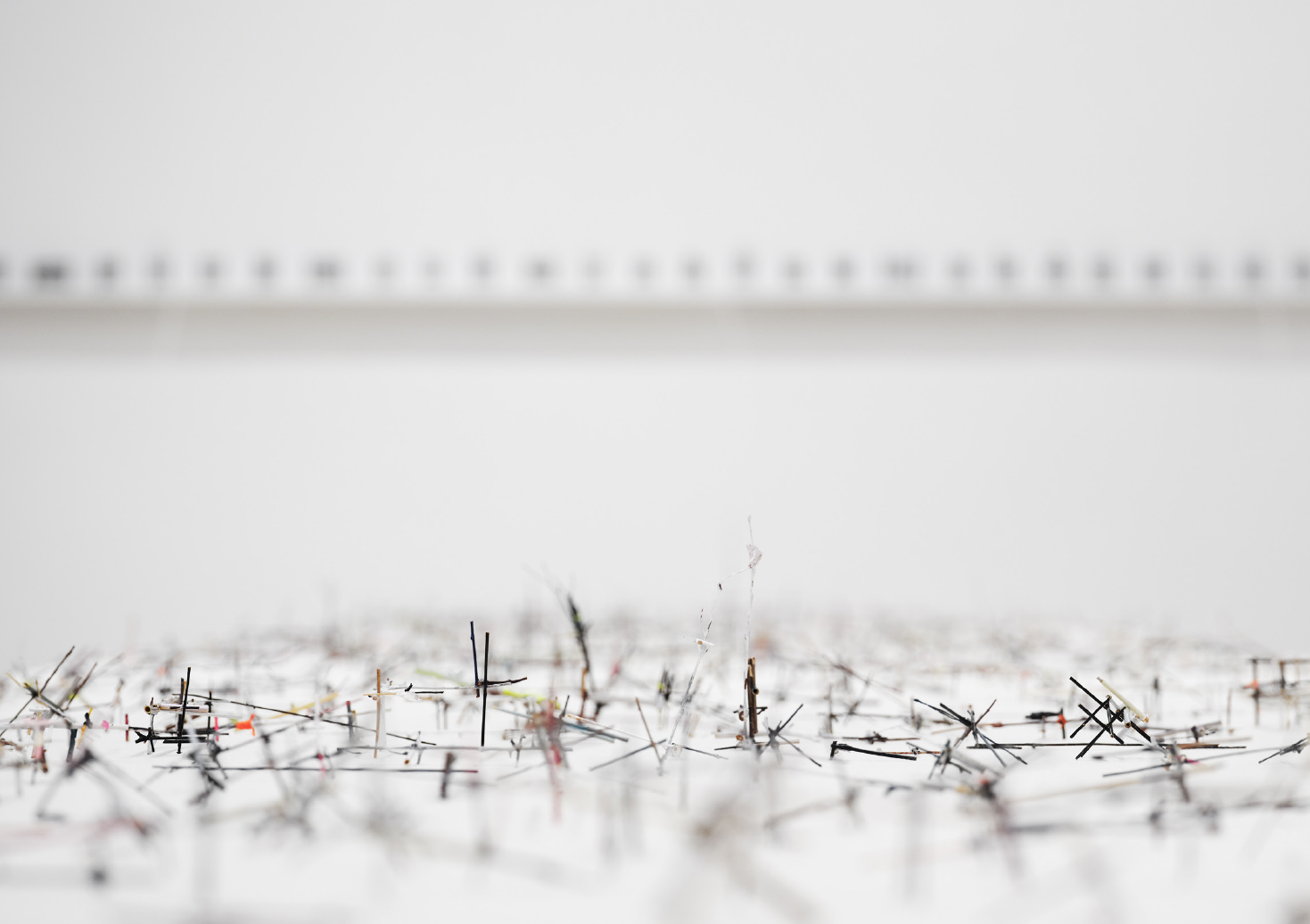
A long table lies littered with hundreds of small fragments, scraps of sticks and twigs. Bits of string bind some together at orthogonals, pointing to the presence of a human hand in their assembly. They suggest broken pieces of larger structures, buildings, perhaps, or implements. They look like debris, really, and the title of this recent work by Anita Groener, Shrapnel, insinuates the violence that may have torn the structures to shreds.
One of the artist’s most abstract works of recent years, Shrapnel’s clean white surface with tiny configurations of, essentially, kindling manages to conjure a vast field littered with ruins. Her use of scale and material psychologize the objects, to borrow a term from Rosalind Krauss, and make it seem as if we view them from a great distance. Yet, instead of alienation, this god’s-eye view provokes a sense of something like loss as we survey the rubble. The humble materials and primitive construction of the posited structures only add to that sensation, implying, as they do, the makeshift, impoverished shelters erected by refugees or migrants.
And, with that, Groener’s almost Constructivist display plunges us right back into history and the news of the day, which has formed the underlying narrative of her practice since at least 2016, when she first deployed twigs to create a body of work in recognition of the crisis of Syrian refugees in Europe. The disasters of war and displaced peoples have only continued to pile up since, loss upon loss, and her new work also calls to mind Afghanistan, Ukraine, Gaza or any number of other locations subject to brutality and carnage that forces the inhabitants to flee, not to mention the increasingly common sight of regions devastated by the effects of global warming, resulting in analogous displacements.
Another work, Cradle, rings the walls of the gallery with some four hundred little boxlike structures, similarly made from twigs. Here, the diminutive constructions remain whole, if precariously ramshackle and contingent. They resemble cages or cribs, less shelters than corrals, and the inclusion of minuscule silhouettes of people in some of them—harking back to the artist’s previous, somewhat more narrative sculptures—makes them into miniature prison cells. Cradle intimates aspects of political violence other than wholesale leveling, from the camps of the displaced to the cells of political prisoners; moreover, its isolated figures appear incarcerated existentially, psychologizing the objects in a quite different manner.
Inflecting our perception of either sculptural work, sound wafts through the gallery at intervals. Wind in the trees, birdsong, a lonely flute playing a melody, and someone whistling some distance away add a cinematic aspect to the installation, underscoring the arboreous nature of Groener’s materials and the general melancholy of her fugue. Titled, Partisan, after a song written in the voice of a French Resistance fighter during World War II—the tune whistled in Groener’s recording—the sound imparts an impression of endurance and defiance to Cradle, yet delineates Shrapnel as a battlefield, just before or just after the slaughter.
Groener takes the viewer, metaphorically, to horrific extremes of the present moment. The mode of address of the exhibition’s title expresses those limits, to the edge of your world, but we know she means to the edge of our world. Yet Cradle’s title alludes to nurture and its structures also recall playpens, the small enclosures designed to keep children safe while they occupy themselves with toys and games. Contemplated in the light of the ludic and the developmental, the scattered elements of Shrapnel might then come to evoke the parts of an erector set or a bin of Lego blocks tipped out on the floor, waiting to be assembled into something new. We can see Shrapnel rehearsing the age-old dance of creation and destruction, and, as we survey Groener’s heartbreaking elegies for a fallen world, the little thing that remains, undaunted, like a whistle in the dark, is the one called hope.
Joseph R. Wolin is a critic and curator of contemporary art based in New York and a Part-Time Assistant Professor in the MFA Photography program at Parsons School of Design. His writing has appeared in Border Crossings, Glasstire, Public, Canadian Art, Frieze, Garage Magazine, Modern Painters, The New Yorker, Time Out New York, and Circa.