
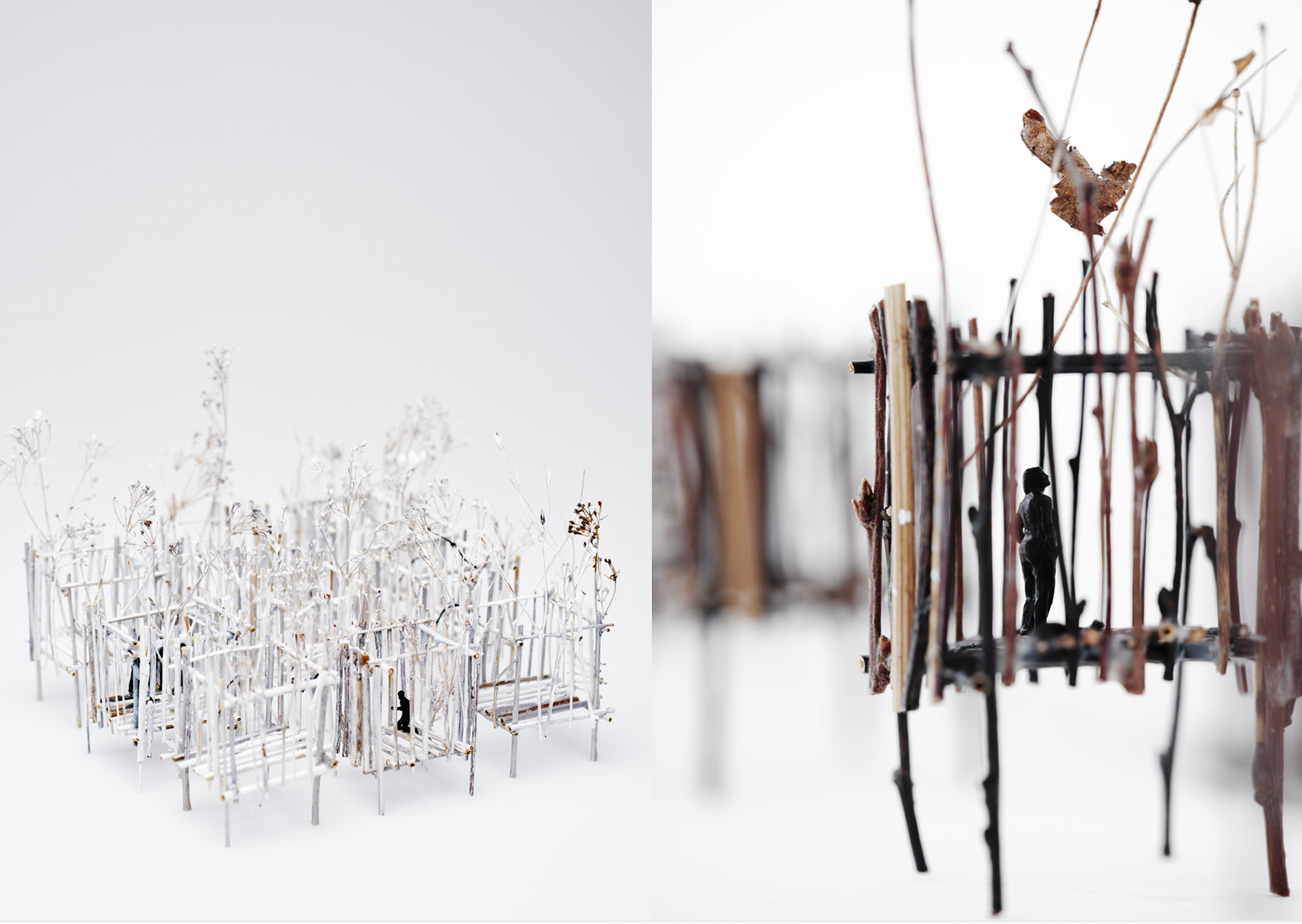
Anita Groener and John Relman You Carry That Moment with You
Anita Groener: Previously, in my work, I attempted to grapple with global events, such as the Syrian refugee crisis in 2015 or the ongoing war on Ukraine. Three years ago, however, we travelled together across the American South, visiting historic sites important to the Civil Rights Movement. We visited Civil Rights museums, trails, and memorials in Memphis, Tennessee; Jackson, Mississippi; and Selma and Montgomery, Alabama. America’s historical, contemporary, and systemic injustices, starkly made tangible on this road trip, profoundly informed the work I have made since. What are your thoughts on connections between the American Civil Rights Movement and the conflicts and struggles now occurring in various other parts of the world?
John Relman: The connections consistently revolve around oppression, the dominance of one group seeking to control another, stripping away rights and privileges for the sake of power and financial exploitation.
One particularly significant connection relates to Ireland, your adopted home, and the Civil Rights struggle here in the United States. The Irish had been oppressed by the British for centuries, leaving a trail of blood throughout that history. That oppression shares a universality with the experience of descendants of Africa in the United States, who have been oppressed in so many ways over hundreds of years. In many respects, these experiences are similar. I believe there is a commonality among those who have suffered such oppression, as they find solidarity in sharing their stories.
In the nineteenth century, Frederick Douglass visited Ireland, shortly after gaining fame in the United States. He went there to share his experiences of what it was like to be enslaved, but he also undertook the trip because of the dangers he faced in the United States as a well-known, formerly enslaved person sharing his story. Later, we see figures like Bernadette Devlin. When the Troubles erupted in Northern Ireland as it attempted to gain independence from Britain, she came to the United States to find meaning and solidarity with the Black experience here. At that time, Irish oppression was ostensibly based on religion, but the real struggle was about the same things she saw in the United States. When she witnessed how people lived separately here, she immediately recognized the parallels with Ireland, particularly Northern Ireland, where Catholics and Protestants did not go to church together, did not attend the same schools, and did not live in the same neighborhoods. They were segregated, too. The same things she saw in Detroit or Chicago, or New York—housing discrimination, economic injustice, discrimination in hiring—were also the issues in Ireland—not hiring Catholics, not giving housing, not providing for the same benefits and quality of life. That is the commonality, when one people or one set of people undertakes to oppress another.
AG The constant factor is the act of recognizing the “other” and saying, “you are different, and that is why we are separating you from us.” In one context, that difference is defined by religion, in another, by race. But the outcomes are remarkably similar.
JR The nature of the human experience has been about power, dominance, wealth, and greed. One people see an opportunity to take advantage of, or exploit, another group of people. There is a long human history of doing that.
AG When we talk about the concept of “othering,” we must remember that race is not a scientific reality but a social construct. The practice of categorizing people by skin color began in the eighteenth century with the Swedish taxonomist Carl Linnaeus, whose classifications laid the foundation for modern racial hierarchy. This system was used to justify a social order that privileged some while oppressing others, a structure that continues to shape society today, particularly in the United States, where racial discrimination remains deeply entrenched.
JR If you go back to the founding of this country, racism—identifying or categorizing people by color—was about political dominance but even more about economic capitalism, about the need to have labor. Since Human capital was a source of enormous wealth before the Industrial Revolution—think about it, that is how work got done—being able to enslave people and then have a justification for enslaving people was convenient and economically profitable. That is how the wealth of America was initially built in the agrarian society.
Today it is done as a calculated political stratagem. It is a type of tribalism, a way to build political power for many in the current sophisticated political environments that you see in fascist regimes, and right now you see it in the United States. If you can point to the “other” and say they are a threat to the community that you define, then you have something that brings people in that community together and gives them a reason to vote for you, because you are going to defend them and their interests against this “other,” against this common enemy.
AG Much of the wealth in the Netherlands was similarly built through colonial exploitation—oppressing and enslaving people and extracting resources from the countries it occupied and pillaged.
When I come to the States, I am conscious of being European but I am also acutely aware of Europe’s role in shaping America’s history. Europeans came here, and that legacy matters. I am interested in historical connections, in systemic causation. Nothing simply happens. Nothing simply is. When we look at present-day conflicts—take Israel and Palestine, for example—many people frame it as beginning on October 7, 2023. But that is only the surface of a long, complex history behind why things are the way they are. Everything is interconnected, just as the Civil Rights Movement, often seen as a uniquely American struggle, connects to broader human rights movements elsewhere in the world.
JR The thing that is special about the American Civil Rights movement is that it really had two elements to it. It had a grassroots aspect, which is best known through the work of Martin Luther King, his protests, his marches, his boycotts. That became seen and heard and understood around the world. It also had a legal component; while Dr. King was leading the grassroots movement, Thurgood Marshall and others, including the NAACP Legal Defense Fund, were leading a legal challenge under the Constitution, saying that these laws that separate us, that deny rights to people based on race, are not allowed under the Fourteenth Amendment of our Constitution. This is a basic flaw of our country that has been in plain sight since its founding, since the Constitution was written in the eighteenth century. That also caught the eyes of the world because everybody knew at some level that there was this hypocrisy about the American experiment. On the one hand, we touted ourselves as the democracy that was the shining light, the shining city on the hill, but on the other hand, we had this history of oppression, slavery, Black codes, and Jim Crow laws that had continued in blatant form into the 1950s and 1960s. It came to a dramatic head in the Civil Rights Movement for the whole world to see. That legal component gave it, at least in the courts, a temporary resolution in the minds of the world. Finally, we were reconciling with this past.
Now, of course, we know that it is never that easy, never that simple. Change sentence to: Notwithstanding those decisions by the Supreme Court, there has been tremendous backsliding; we remain segregated in our schools and in our housing, and we face racial disparities in wealth and opportunity, and new, invidious forms of discrimination and exploitation that are almost as bad as they were in the 1960s. It is a constant battle. Oppression happens everywhere and anywhere there is an opportunity for it to happen. No society, no country is safe from it. And now we know there is no legal construct that prevents it from happening. In that sense, it is part of the universal human condition.
On our “Civil Rights” trip together, we noticed, as visitors often do, things that stand out. I think the form of oppression here is quite different from what you have experienced in modern European history, or in Ireland. In the U.S., there were laws enforcing segregation, and even when those laws were overturned, deeply ingrained customs and social patterns continued to keep people apart.
The only country close to the United States in that respect was South Africa. There really is an apartheid here in the United States and that is shocking for people. I think it was shocking for you to see and to understand, when we were on that trip, just how people were forced to live apart and what the consequences of that were, but also the violence.
AG The violence struck me profoundly when we walked through the Legacy Museum in Montgomery, Alabama. I had never encountered anything like it. It was an incredibly powerful emotional experience. I remember thinking that everyone should make this journey to visit the Legacy Museum and the National Memorial for Peace and Justice. It was overwhelming. I cried. The architecture, the atmosphere, the descent into that space, all of it created a visceral sense of the horror endured by so many. It left a deep imprint on me. It silenced me.
I have visited the U.S. several times, but that trip marked a turning point. It revealed, in stark detail, the enduring legacy of systemic racism in America: four centuries of racial thinking embedded in the culture. It is in the language, in the way people speak, behave, think, and classify both themselves and others. It is everywhere, yet often invisible to those who benefit from it. Most people do not notice.
After that experience, I read Claudia Rankine’s Just Us: An American Conversation—the title sounds like “justice” when spoken aloud. It explores white privilege and the omnipresence of white entitlement, much of it unconscious. Her writing made me realize how easily we fall into habitual speech and thought patterns that perpetuate prejudice, and how these patterns replicate themselves quietly but persistently across society.
Our “Civil Rights” trip coincided with the outbreak of the war in Ukraine in 2022, and I could not help but draw connections between what I witnessed in the U.S. and what was unfolding in Europe. I kept asking, what drives people to inflict such harm on each other? Russia’s invasion brought into sharp focus the power of historical narratives. Ukrainians have long been labelled “Little Russians,” viewed as lesser or peripheral, an identity imposed from outside. Today’s violence is political, yes, but the psychological and historical roots feel disturbingly familiar.
I remember our conversations about Freud’s concept of the narcissism of minor differences, how communities that once lived together peacefully can begin to obsess over the smallest distinctions, turning them into deep divisions. These distinctions become tools for reinforcing identity, ways of declaring, “I am not you.” And while forming identity is necessary, societies often struggle to tolerate sameness that is not quite the same.
As a migrant living in another culture, I see that tension—the expectation to integrate, to belong. Yet no matter how well you adapt, you carry your history with you. You are never fully of the place. There is always a boundary, visible or not, that holds you at a distance.
JR The ability to point to the “other” and to win political power by saying, “I'm going to protect you from the other,” to fan the flames of fear, is what politicians exploit to rally support, to create a sense of threat from outsiders.
AG What role can art play in these contexts? How can it affect us? Are there, for instance, particular works of art that affected you, stayed with you?
JR Photographs of the Civil Rights Movement move me like nothing else. They capture a moment and a person and they are very intimate. You can feel what individuals were experiencing at that moment, what they were facing. It was a moment of tremendous personal courage.
Photography can connect a person who sees it to a moment in time. It creates a feeling in you and gives you a bond with
an individual, a place, a historical moment or event. I think of those images of Dr. King at Dexter Avenue Baptist Church in Montgomery, looking at the faces of people looking at him, seeing what he saw; and photos of him being arrested for loitering in Montgomery, an individual powerless in the face of this enforcement mechanism that could have killed him at any moment; and pictures of John Lewis on the bridge in Selma before he is beaten. These are individuals who showed unbelievable courage for an idea, for a principle, for a hope of a better life, for other people, not knowing what the outcome would be but just believing in this idea. I find it not just inspiring, not just moving, I feel a connection. It makes me feel connected to the best of what humanity can be about. The best of humanity in my view are those who can commit to living and working for a better world, both for those who have been oppressed and those who will come in the future.
AG I have always been drawn to issues of human and civil rights but what truly shifted my motivation—what changed how and why I make art—was witnessing the Syrian refugee crisis unfold in 2015. It affected me deeply, just as our “Civil Rights” trip did, and as do so many of the conflicts we continue to see around the world, both past and present.
Like you, I am moved by the extraordinary courage of people who stand up for an idea, for freedom. What unites us as human beings, across all creeds and races, feels more vital, more urgent than ever. In a world that feels increasingly fractured, that shared humanity is what we must hold on to and work to repair.
For me, as an artist, it is vital to develop a visual language that conveys the weight of experiences like our “Civil Rights” trip. My current exhibition is directly connected to visiting the Civil Rights monuments in Memphis, Jackson, Selma, and Montgomery, but it also reflects on other conflicts happening globally today, events that touch us all.
The installation Cradle, at first glance, suggests protection, safety, birthplace, and support. Yet, it can also be seen as a prison. This ambiguity was inspired by the Legacy Museum’s portrayal of the mass incarceration of Black people—how history is shaped and contained within structures, physical and symbolic. The title Cradle is deliberately open-ended. A cradle can nurture or confine, depending on your perspective and circumstances. How you interpret these objects as a viewer is shaped by personal history and circumstances. The spaces in my installations are meant to invite reflection. If the work has moved you, even in a small way, it might shift how you see and engage with the world around you. If that happens, I feel the work has succeeded in its intention.
JR When you visited the Legacy Museum you went back three times. I remember that you were very struck by the mass incarceration aspect. Of course, that is the genius of Bryan Stevenson [the founder and Executive Director of the Equal Justice Initiative, a human rights organization that has won major legal challenges eliminating excessive and unfair sentencing, exonerating innocent death row prisoners, confronting abuse of the incarcerated and the mentally ill, and aiding children prosecuted as adults. He led the creation of EJI’s highly acclaimed Legacy Sites, including the Legacy Museum, the National Memorial for Peace and Justice, and Freedom Monument Sculpture Park, new national landmark institutions that chronicle the legacy of slavery, lynching, and racial segregation, and the connection to mass incarceration and contemporary issues of racial bias]. The narrative he wants Americans to understand about our past is that the criminal justice system has been used here to impose that will, to maintain apartheid and to perpetuate the exploitation of Black people. That has been a consistent part of the American narrative that many forget or never understood—that the legal system was as biased and discriminatory as everything else in American society, used as a way to sustain oppression and uphold that power structure.
Your art explains certain truths. My first exposure to your work was your beautiful circle, a 2016 work called Citizen. As you stand far away, it is abstract. As you come closer, you see, no, this is about individuals. And each individual is different. Every person has a story. Immigrants can be demonized if they are a group. But as soon as you get close enough to see the individual, you are seeing a person, the individual story—you shine a light on it. I remember you saying, “You have to look at the shadows that they create.”
People are driven from their homes and forced to move from place to place, and are forced to live in the shadows of society. Every time I look at Citizen, I think about that, people living in the shadows. So, what you have done is to expose people to new ideas through your art. You allow me to think about the immigrant struggle in a different way.
You have done that for many years now with the human rights struggle over immigration. You create the ability for people to have a counternarrative to what they hear in the news all the time, from leaders who want you to believe something different.
AG , I try to visualise that universal experience of loss we all face at some point in life, but it is an experience that is hard to see or share. When my parents died within five weeks of each other, I was in the middle of making an exhibition. I remember asking myself how am I going to get through this? Where do I put this grief? What form, what color, what pattern, what material, what weight does this loss carry? How do I translate such a personal emotional experience? I realized that personal loss is something you cannot hand off to someone else, like saying, “Hey, can you hold this for a moment?” It’s more like giving birth. There’s no pause, no break. You have to go through it. My grief isn’t like anyone else’s grief, but I can see your pain. I can see the “other,” or, at least, I can choose to see them.
This understanding shaped my approach. I create a psychological distance in my work through the use of scale. From afar, the pieces appear abstract, concealing the human story. But as you draw nearer, the figures reveal themselves. You begin to see the individual, and that recognition is vital. Distance allows reflection; close-up reveals emotional truth.
JR That really is connected with the National Memorial for Peace and Justice, which is about lynching. Many Americans do not understand that there were more than 4000 lynchings that took place as a form of institutional terror, but, more importantly, as a form of terror. Terrorizing the Black population, post slavery, post-emancipation, was done to ensure that the racist power structure of white society in the South remained firmly in control even after slavery had been abolished and that there would be consequences for anybody who defied that. Lynchings contributed to the migration of millions of Black people in the early twentieth century from the South to the North, where, of course, they were discriminated against again in Northern cities. It was a migration based on terror. Yet, Americans put that out of their minds because that was long ago. It is hard to imagine the terror of a lynching. But when you walk into the National Memorial for Peace and Justice, you see these giant monoliths hanging, you walk between them, and all of a sudden, you can feel the sensation of hanging by your neck. To think about it forces you to ask why it would have been done. What was it for?
AG Art has an emotional impact that communicates across time and place. There you are, walking among abstract sculptures, but through the art, you feel a connection. You feel the weight of these stories. You go underneath these COR-TEN Steel monoliths, which represent this lynching, this hanging, these bodies, because they are relative to human scale.
JR Bryan Stevenson tells the story about the project that he initiated, which involved sending volunteers to the places where lynchings had happened to dig up soil and having family members dig up the soil and put it into jars. These jars are displayed in the Legacy Museum as part of an exhibit about lynching. One of the volunteers, an older Black woman, who went to a particular site in Alabama where a lynching had taken place, went there on her own. It was a county where she was from and where her family members were from. She stops her car on the side of the road, all alone, and she goes to dig up and put the soil in the jar. Then, she sees a pickup truck coming down the road the other way, and it slows down, it stops, then it turns around, comes back and stops again. There is a white man in the truck and he gets out and says, “What are you doing?” And the fear starts to well up in her. She said that she remembered that Stevenson had told her, “If you are ever stopped and people ask what you want, you can always just say, ‘Um, I'm taking a, you know, a memory or a piece of something from here. That's all.’” But she said that at that moment she had to say the truth and she said, “There was a lynching that happened here, and I'm taking up this soil to bring it back to a museum in Montgomery.” And the white man walks over and asks, “Can I help you?” He starts digging up the dirt with his hands, and he puts it into her jar. No one is saying anything to the other. Then, all of a sudden, tears start to roll down this older white man's face, and she turns to him and says, “Why are you crying?” And he said, “Because it could be that one of my family members was involved in the lynching.”
I think that to see these sites, to say that at this place this horrible thing happened, forces us to reflect on what happened and why, after we face that in our mind. It can be cleansing. It can be an expiation. It can be all of that because we confronted it, saw it, felt it, and it has made an impression on us. And you say, “Now I can move forward. I can accept that this happened, and it is not going to happen again on my watch. I am going to make sure that, in my limited lifetime, this does not happen.” You carry that moment with you.
This conversation was recorded in Royal Oak, Maryland, USA, on June 5, 2025.
John P. Relman is the Founding Partner of Relman Colfax in Washington, DC. For more than thirty years, he has represented individual plaintiffs, cities, and civil rights organizations in many of the most important civil rights cases in the United Staes. Widely recognized as one of the nation’s leading civil rights lawyers, John has pioneered groundbreaking fair housing and fair lending cases that have expanded the scope and reach of the Fair Housing Act.